
NEAR House of Stake Proposals and Voting Guide
This guide is written for anyone who wants to submit a proposal to the House of Stake (HoS). It explains how proposals are created, developed, reviewed, and ultimately voted on.
Overview
Any NEAR tokenholder can submit a proposal, known as a House of Stake Proposal (HSP). The starting point for any proposal is at houseofstake.org , hit “Create Proposal” on the top right and follow the prompts.
There are two types of proposals at House of Stake:
- Classic Proposal — estimated timeline: 36–42 days
- Fast Track Proposal — estimated timeline: 14–21 days
Create your proposal at houseofstake.org as a draft. It will be auto-posted to the House of Stake forum.
A 100 NEAR deposit (bond) is required to create a Fast Track proposal. This bond helps ensure that proposal submitters are accountable and tied to the outcome of their proposal.
1. Classic Proposal
A Classic Proposal follows the standard governance process. It includes a 7-days mandatory community feedback period, review stages, tokenholder voting, and final review before execution.
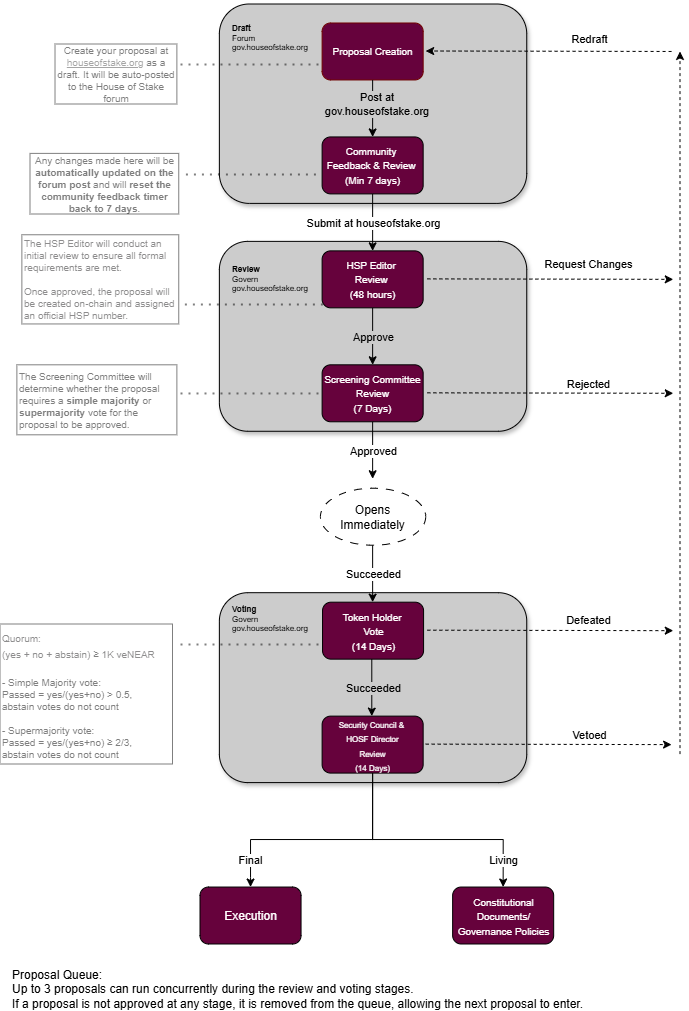
Step 1: Proposal Creation
Create a Classic Proposal at
https://gov.houseofstake.org/proposals
and save it as a draft.
Your proposal will automatically be posted to the NEAR House of Stake forum, where the community can review it, provide feedback, and engage in early discussion.
Step 2: Community Feedback & Review
After the proposal is posted, it enters the Community Feedback & Review stage.
Minimum review period:
7 days
During this period, the community may review, discuss, and provide feedback on the proposal.
To make changes, edit your current draft at https://gov.houseofstake.org/proposals
Each update will be automatically reposted to the forum. Note: Any changes to your proposal will restart the 7-day feedback period.
Step 3: HSP Editor Review
After the community review period is completed, the proposal enters the HSP Editor Review stage.
Review period:
48 hours
The HSP Editor will conduct an initial review to ensure all formal requirements are met before it moves to the next stage.
Possible Outcomes
| Outcome | Result |
|---|---|
| Approved | Proposal is tagged with an HSP number and moves to Screening Committee Review |
| Request Changes | Proposal is sent back to the proposal author with notes |
Once approved by the HSP Editor, the proposal is created on-chain and assigned an HSP number.
Step 4: Screening Committee Review
After HSP Editor approval, the proposal moves to the Screening Committee Review stage.
Review period:
7 days
At this stage, the Screening Committee reviews the proposal before it can proceed to voting. The Screening Committee will also determine whether the proposal requires a Simple Majority or Supermajority vote. (see House of Stake Constitution and Proposal and Voting Procedures)
Quorum Requirement
For a vote to be valid:
Yes + No + Abstain ≥ 1,000 veNEAR
Simple Majority Vote
A proposal passes by Simple Majority if:
Yes / (Yes + No) > 50%
Abstain votes are excluded from the approval percentage calculation.
Supermajority Vote
A proposal passes by Supermajority if:
Yes / (Yes + No) ≥ 67%
Abstain votes are excluded from the approval percentage calculation.
Possible Outcomes
| Outcome | Result |
|---|---|
| Approved | Proposal opens for voting immediately |
| Rejected | The proposal process ends, the proposal is removed from the queue. The Screening Committee provides a rationale, and the author may revise and resubmit it by restarting from step 1. |
Step 5: Tokenholder Vote
After the proposal opens for voting, it enters the Tokenholder Vote stage.
Voting period:
14 days
Tokenholders vote on whether the proposal should pass.
Possible Outcomes
| Outcome | Result |
|---|---|
| Succeeded | Proposal passes, and moves to Security Council & House of Stake directors review. |
| Defeated | Proposal fails, proposal process ends. |
Step 6: Security Council & House of Stake Foundation Director Review
If the proposal succeeds in the Tokenholder Vote, it moves to the final review stage.
Review period:
14 days
The Security Council and House of Stake Foundation Directors review the proposal before final approval.
The Security Council acts as a final protection layer after voting and reviews whether the proposal aligns with the vision, mission, and values of House of Stake, and whether it may negatively affect the NEAR ecosystem (see House of Stake Bylaws).
The House of Stake Foundation Director may decline to implement a proposal if it is unlawful, breaches obligations, or compromises integrity or interests (see House of Stake Constitution).
A veto should be exercised only in cases involving significant governance, ecosystem, legal, financial, technical, or execution concerns.
Possible Outcomes
| Outcome | Result |
|---|---|
| Approved | Moves to final outcome |
| Vetoed | Proposal fails, and proposal process ends. |
Step 7: Final Outcome
If the proposal passes all required stages, it will proceed to one of the following outcomes:
Final Proposal
The proposal moves to:
Execution or implementation of approved changes
Policy Proposal
If the proposal relates to governance rules, constitutional documents, or policy changes, it may become part of:
Constitutional Documents / Governance Policies
2. Fast Track Proposal
The Fast Track Proposal process offers a shorter approval and voting timeline, using an accelerated review and voting process compared to a Classic Proposal.
-9c0b3f9856c6166c4b1d6503e84ff1f3.png)
Step 1: Proposal Creation
Any NEAR tokenholder can submit a Fast Track House of Stake Proposal (HSP). The starting point for any proposal is at gov.houseofstake.org. Click “Create Proposal” on the top right and follow the prompts.
A 100 NEAR bond deposit is required to create a Fast Track Proposal. This bond helps ensure that proposal submitters remain accountable for the quality, seriousness, and outcome of their proposal.
Once submitted, the proposal will be automatically posted on the House of Stake forum for review.
Step 2: Community Feedback & Review
A Fast Track Proposal may go through the Community Feedback & Review stage, but this stage has no minimum duration.
Any changes made during this stage are automatically reflected in the forum post.
If needed, the proposal may be sent back for redrafting.
Step 3: HSP Editor Review
The HSP Editor will conduct an initial review to ensure all formal requirements are met before it moves to the next stage.
Maximum review period:
48 hours
The HSP Editor reviews the proposal to ensure that it is clear, complete, properly formatted, and suitable for Fast Track consideration.
Possible Outcomes
| Outcome | Result |
|---|---|
| Approved | Proposal is tagged with an HSP number and moves to Screening Committee Review |
| Request Changes | Proposal is sent back for redraft |
Once approved by the HSP Editor, the proposal is created on-chain and assigned an HSP number.
Step 4: Screening Committee Review
After HSP Editor approval, the proposal enters the Screening Committee Review stage.
Maximum review period:
48 hours
At this stage, the Screening Committee reviews the proposal before it can proceed to voting. The Screening Committee will also determine whether the proposal requires a Simple Majority or Supermajority vote.
Quorum Requirement
For a vote to be valid:
Yes + No + Abstain ≥ 1,000 veNEAR
Simple Majority Vote
A proposal passes by Simple Majority if:
Yes / (Yes + No) > 50%
Abstain votes do not count toward the approval percentage.
Supermajority Vote
A proposal passes by Supermajority if:
Yes / (Yes + No) ≥ 67%
Abstain votes do not count toward the approval percentage.
Possible Outcomes
| Outcome | Result |
|---|---|
| Approved | Moves to Sandbox Vote |
| Deferred | Bond returned |
| Rejected | Bond slashed |
Note: Any slashed bond will be sent to the HOS Treasury.
Step 5: Sandbox Vote
After Screening Committee approval, the proposal enters the Sandbox Vote stage.
Voting period:
7 days
To pass this stage:
At least 30% of votes must be in favor
If the Sandbox Vote passes, the favor votes are carried over to the Tokenholder Vote.
Step 6: Proposal Opens for Voting
If approved, the proposal opens for voting on the following:
Monday, 3 PM UTC
The proposal then enters the Parallel Voting stage.
Step 7: Parallel Voting & Review
Fast Track Proposals go through Parallel Voting & Review stage.
Maximum voting/review period:
5 days
The two parallel paths are:
- Tokenholder Vote
- Security Council & HSP Director Review
The Security Council and House of Stake Foundation Directors review the proposal before final approval.
The Security Council acts as a final protection layer after voting and reviews whether the proposal aligns with the vision, mission, and values of House of Stake, and whether it may negatively affect the NEAR ecosystem (see House of Stake Bylaws).
The House of Stake Foundation Director may decline to implement a proposal if it is unlawful, breaches obligations, or compromises integrity or interests (see House of Stake Constitution).
A veto should be exercised only in cases involving significant governance, ecosystem, legal, financial, technical, or execution concerns.
Possible Outcomes
| Outcome | Result |
|---|---|
| Approved | Moves to final execution |
| Defeated | Bond returned |
| Vetoed | Bond slashed |
Note: Any slashed bond will be sent to the HOS Treasury.
Step 8: Final Execution
If the Fast Track Proposal passes the required voting and review stages, the bond is sent to the HOS Treasury, and the proposal proceeds to:
Execution
Proposal Queue
Up to 3 proposals may run concurrently during the review and voting stages.
If a proposal is not approved at any stage, it is removed from the queue. This allows the next eligible proposal to enter the process.