
House of Stake 2.0: Toward a Treasury Governance Engine

House of Stake successfully launched NEAR’s stake-based governance system. Over 5 million NEAR have been locked in the governance system to date, reflecting early ecosystem participation. Today, we introduce House of Stake 2.0, NEAR’s Treasury Governance Engine.
Token-based, Stakeweighted Governance
At its core, House of Stake enables any NEAR tokenholder to lock tokens and acquire governance power. Delegates can vote and submit proposals. The Screening Committee and Security Council provide essential checks and balances, safeguarding the system from malicious behavior and ensuring House of Stake remains aligned with its mandate. Long term, the House of Stake Foundation envisions broad participation across NEAR’s core stakeholders, and enable meaningful participation for both tokenholders and active contributors, such as validators.
Each group brings critical perspective. Sustainable, high-quality decision-making requires aligned participation from across the ecosystem.
A Sharp Mandate: Economic & Treasury Governance
House of Stake exists to empower tokenholders to govern the NEAR ecosystem collectively and responsibly. But governance must be focused.
NEAR House of Stake has learned from past DAO experiments across the industry. Governance without a clear mandate drifts. House of Stake 2.0 introduces a refined mission:
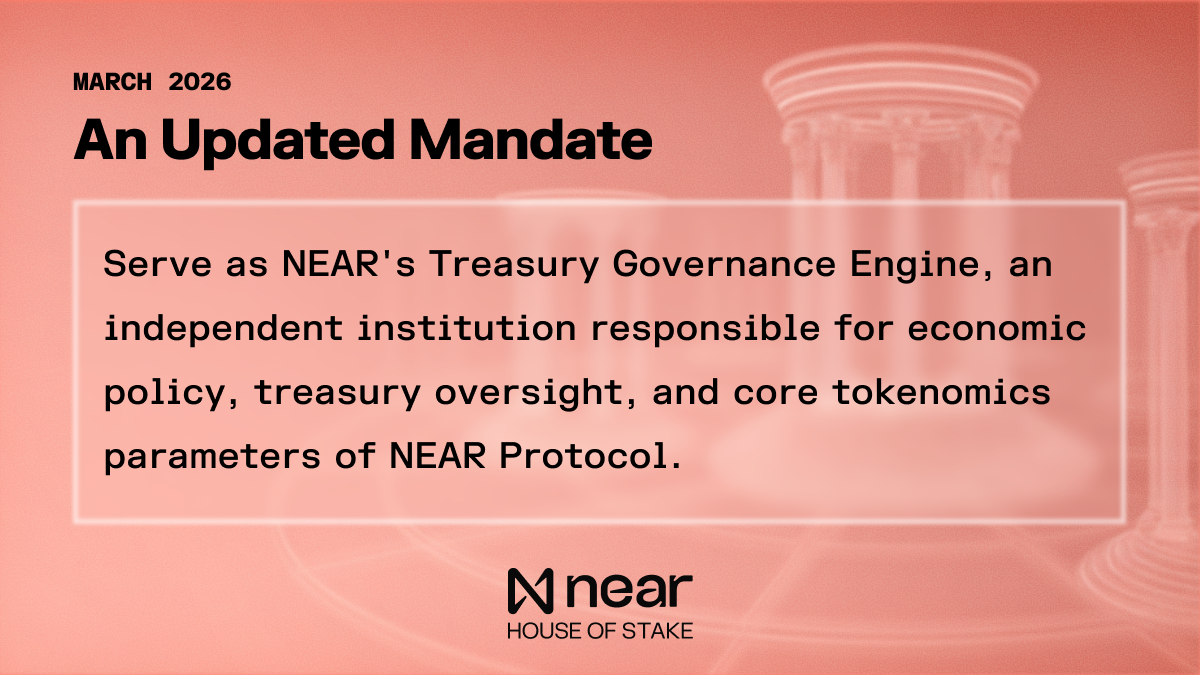
House of Stake aims to act as NEAR’s Treasury Governance Engine — an independent body focused on economic policy, treasury oversight, and key tokenomics decisions, while remaining accountable to community governance and regulatory requirements.
Long-term, its core responsibilities may include:
- Facilitating community governance of ecosystem economic parameters
- Managing treasury strategy and deployment
- Defining and adjusting key tokenomic parameters
- Overseeing value accrual mechanisms that support long-term ecosystem health.
As the NEAR ecosystem grows and network usage increases – including activity through NEAR Intents and other ecosystem products – House of Stake may gradually take on stewardship of these funds, subject to community governance and regulatory conditions. The long-term objective is clear: To support responsible, community-governed stewardship of ecosystem revenues and, over time, broader NEAR treasury operations.
Explicit Goals of House of Stake 2.0
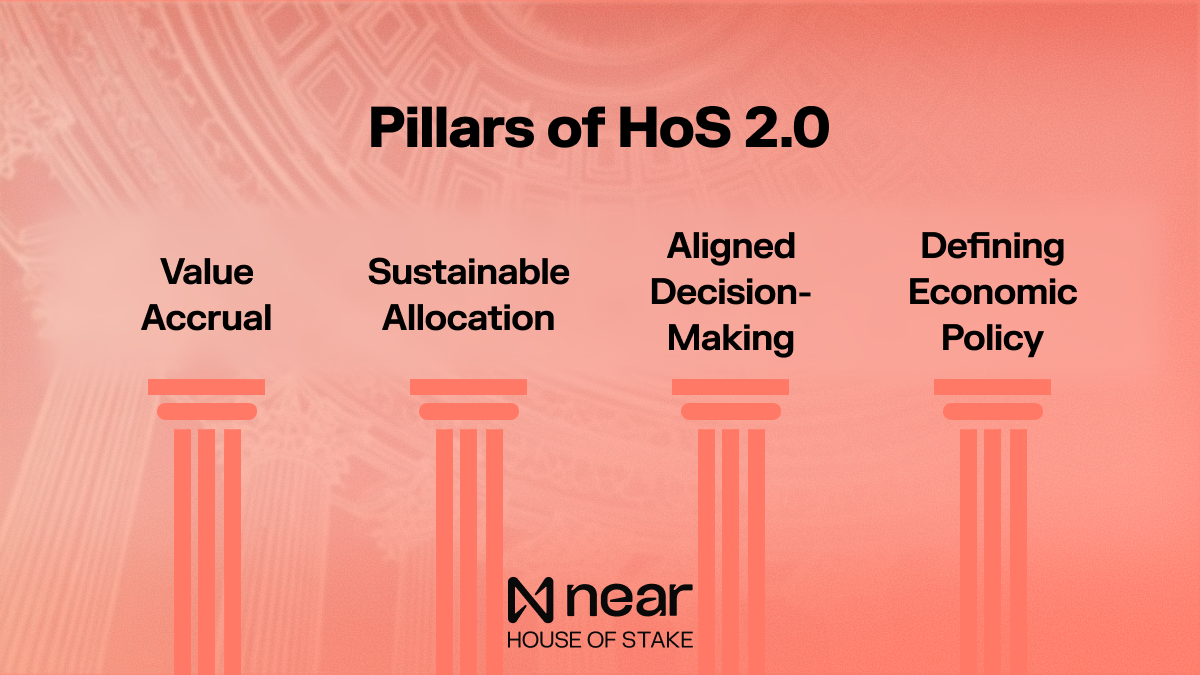
House of Stake’s mandate can be summarized in four pillars:
Value Accrual
Support the long-term health and utility of the NEAR ecosystem through transparent governance.
Sustainable Allocation
Deploy revenues strategically to nurture long-term ecosystem growth.
Aligned Decision-Making
Enable token-based governance that aligns incentives across stakeholders and strengthens NEAR’s long-term resilience.
Defining Economic Policy of the NEAR Ecosystem
Coordinating future updates to emissions, fees, and incentive design as the NEAR ecosystem scales and adoption expands.
What does this mean in practice?
Over the coming months, House of Stake will focus on proposals around Ecosystem Value Accrual & Economic Sustainability:
- Exploring approaches to ecosystem value accrual
- Exploring approaches to managing NEAR ecosystem assets in the long-term interest of the protocol. (such as top-level accounts)
- Evaluating approaches to long-term economic sustainability, including responsible governance of protocol economic parameters.
A detailed update on House of Stake’s expanded mandate and scope will be published in the upcoming Season announcement. These efforts are designed to strengthen House of Stake as a robust, compliant, and secure governance system, suitable for diverse stakeholders across various jurisdictions.
Introducing the New House of Stake Core Team
To execute on this expanded mandate, a streamlined and focused core team has been formed.
Governance & Operations Workstream:
- Head of Governance
- HoS Operations Manager
- Responsible for governance design, administration, and serving as the interface between House of Stake tokenholders and the HoS Foundation, the legal entity established to support the operational, legal, and administrative needs of House of Stake initiatives
Product & Protocol Workstream:
- BuilderOps Contributors and Engineering Team (Focused on backend, smart contracts, and infrastructure; driving product development and operational execution.)
- Agora Front-End Team (Support with front-end fixes, bugs, docs and troubleshooting.)
The team’s objective is to operate as a lean, agile unit focused on product excellence and operational efficiency.
Core Team Roadmap (Next 3–6 Months)
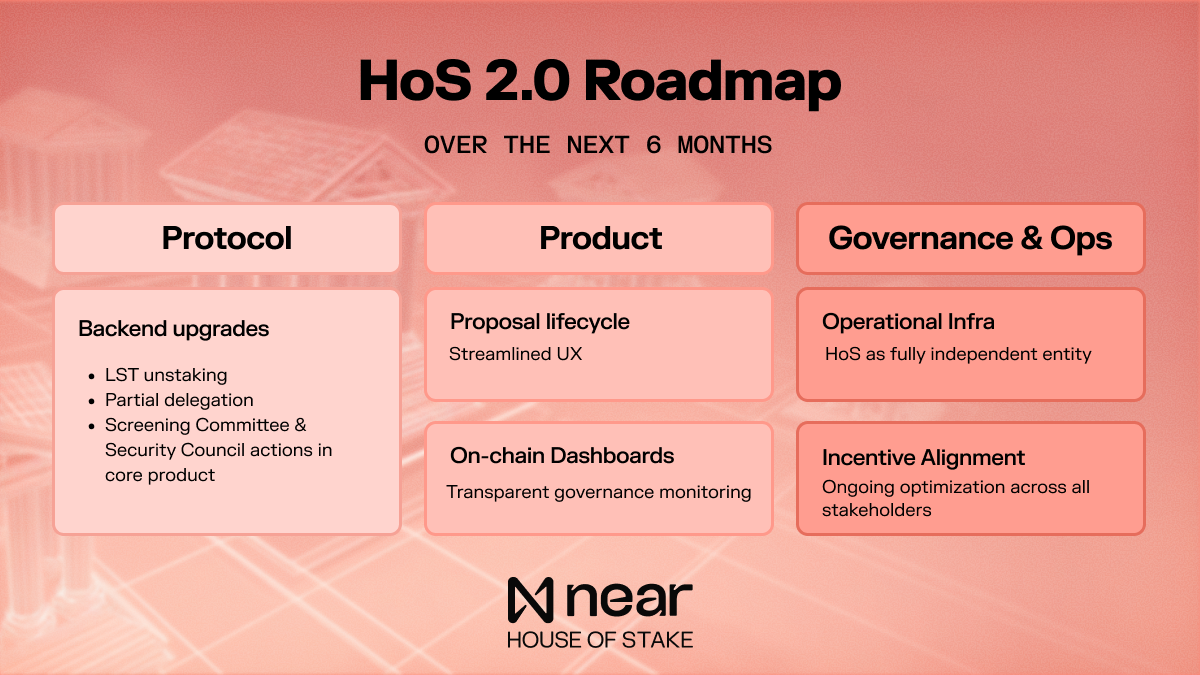
a) Upgrade the HoS backend to support:
- LST unstaking
- Partial delegation
- Integrating Screening Committee and Security Council Actions in the Core Product.
b) Streamline the proposal lifecycle with first-class UX
c) Launch on-chain dashboards enabling transparent monitoring of governance activity and outcomes
d) Establish operational infrastructure for House of Stake to function as a fully independent entity
e) Continuously monitor and optimize incentive and decision-making mechanisms to ensure alignment across validators, tokenholders, and ecosystem builders
Conclusion: The Treasury Governance Engine
House of Stake 2.0 is NEAR’s Treasury Governance Engine.
Our focus is clear: to support transparent, community-driven governance of NEAR's economic parameters and treasury in the long-term interest of the ecosystem.
This is not about slow, bureaucratic governance or endless formal procedure. A Treasury Governance Engine must be decisive, efficient, and adaptable. It must respond to market realities, support informed governance decisions, adapt to evolving ecosystem needs, and foster transparent, community-driven processes.
Lean. Focused. Accountable.
Built to support transparent governance of NEAR's economic ecosystem.
Disclaimer:
Nothing in this communication constitutes investment advice, a solicitation, or an offer to buy or sell any token or other financial instrument. The strategies, tools, and approaches discussed are subject to change and may be modified or discontinued at any time based on regulatory developments, governance decisions, or other factors. NEAR token holders have no rights vis-à-vis the NEAR Foundation and NEAR House of Stake Foundation.