

Most digital accounts you are relying on today are ultimately controlled by someone else.
Your username, your business identity, or even the account an AI agent operates through can exist at the discretion of a platform. If that platform owner changes its rules, suspends the account, or disappears, the identity and value connected to it may disappear too.
Self-custody solves part of that problem, but introduces another: lose your keys, and you may lose the account permanently.
House of Stake is helping bring a different model to NEAR.
Top Level Accounts and Recovery Keys are now live, giving users, businesses, and autonomous agents access to accounts that are owned onchain, usable across the NEAR ecosystem, and recoverable without handing permanent control to a centralized platform.
This vision has existed since the early design of NEAR. The NEAR whitepaper described an Account Primitives layer where humans, contracts, devices, and other actors could have first-class accounts directly within the network.
Through nearaccounts.com, that vision is now becoming usable infrastructure.
For House of Stake, this also represents an evolution of onchain governance. Governance should not only decide how resources are allocated. It can also coordinate and deliver services that strengthen the network itself.
Top Level Accounts and Recovery Keys are an early example of that model.
A name that is also a NEAR account
A Top Level Account is not simply a username or identity layer.
A name such as alice.acme is a real NEAR account with its own balance, address, transaction history, and ability to interact with the network.
It can:
- Hold NEAR, tokens, and NFTs (unique digital items).
- Receive payments and use the account with NEAR apps.
- Send transactions or call contracts when the action is supported.
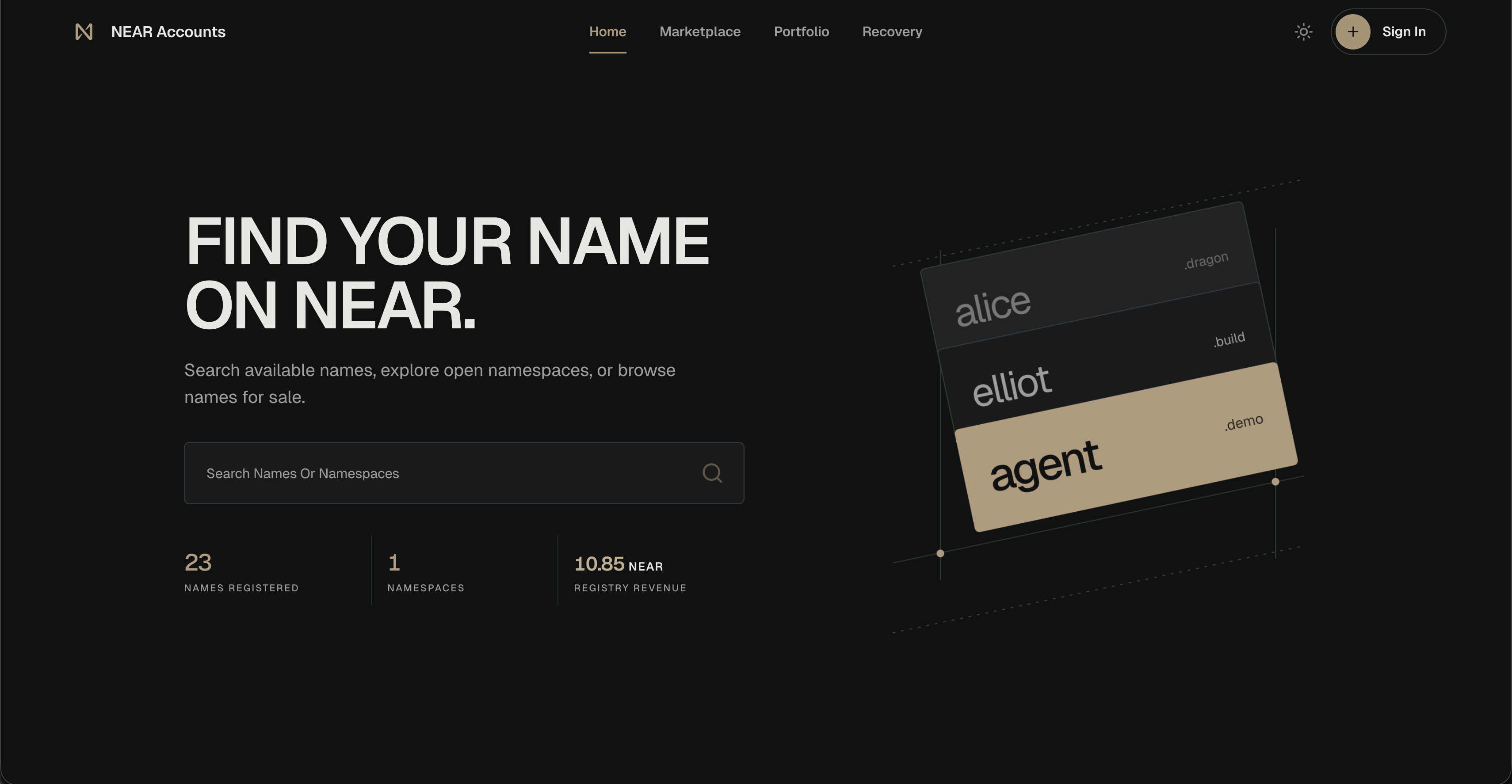
Users can search available namespaces, register a name, and begin using it immediately.
Names can also be transferred or listed on the nearaccounts.com marketplace, with ownership control transferring atomically.
How account control works
Top Level Accounts are keyless by design and do not hold or accept full-access keys. Instead, ownership is enforced through NEP-641 account binding, with the authorized controller recorded onchain through the account’s ownerID.
To operate a Top Level Account, the bound .near account sends a signed transaction to the TLA wallet contract. The contract verifies that the account initiating the transaction matches the recorded ownerID before relaying the authorized action to the v1 signer.
Transfers, sales, and recovery therefore update who is authorized to control the account rather than replacing or transferring an underlying private key. There is no TLA private key that can be read, stolen, or lost.
For leased Top Level Accounts, users retain full control over the account and any assets held within it for the duration of the lease. Neither House of Stake nor the nearaccounts.com product team has any mechanism to redirect, freeze, or take custody of those assets.
Sensitive operations such as AddKey, DeleteKey, and DeleteAccount are restricted, separating everyday account usage from permanent control over the account itself.
Users can also freeze their own account if they believe their authorization credentials have been compromised.
One current limitation is that Top Level Accounts cannot directly register themselves as NEAR network validators.
House of Stake becomes the TLA Registrar
The launch introduces an important new responsibility for House of Stake.
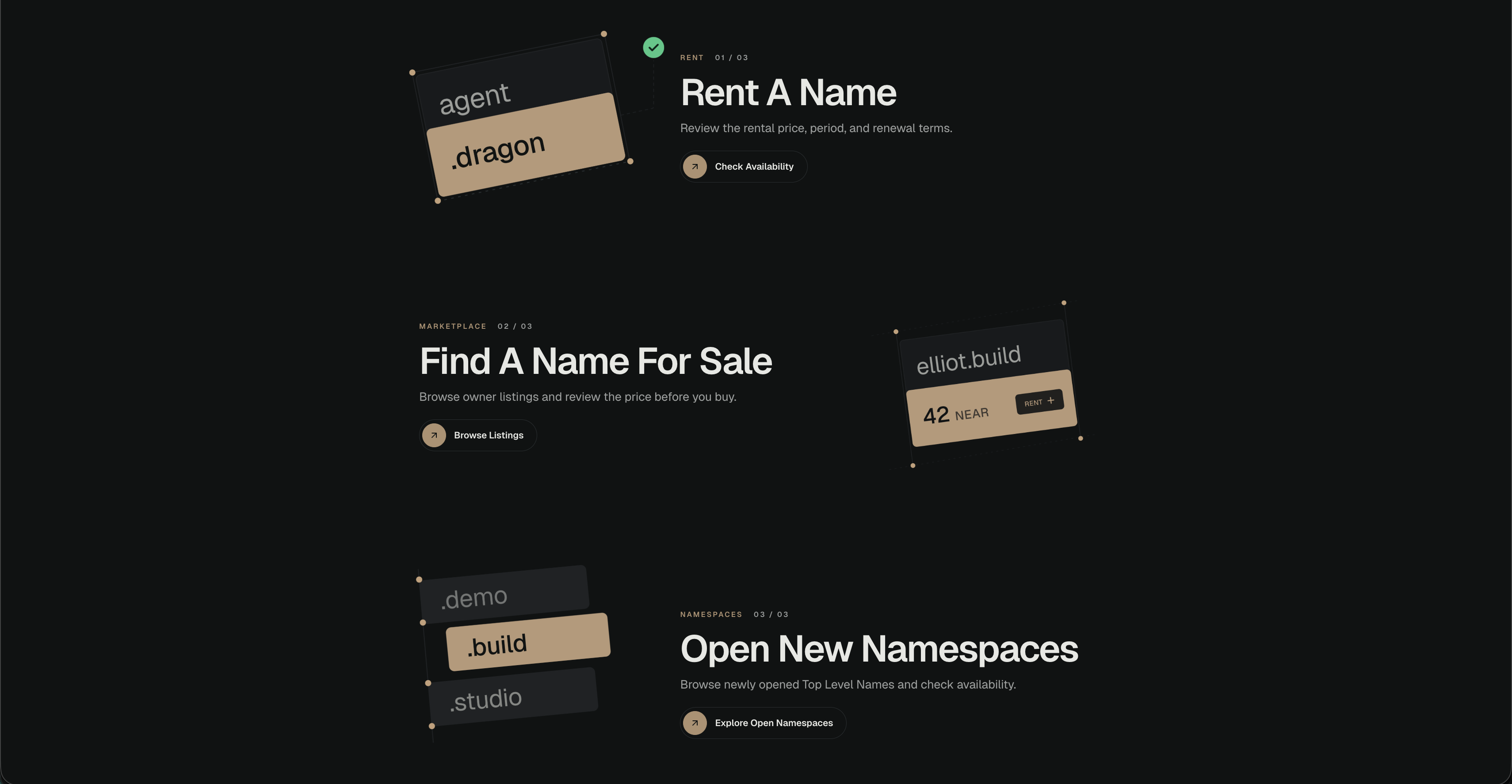
Following HSP-028, House of Stake governance oversees the Top Level Account namespace, with the House of Stake Security Council serving as the Registrar.
The Registrar has a narrowly defined role: verifying valid TLA creation instructions, executing approved registrations through the required signing process, maintaining the necessary infrastructure, and helping protect the system during serious security incidents.
Importantly, the Registrar does not decide which names should be allocated, how much they should cost, marketplace rules, leasing terms, or other commercial decisions. Those remain with the nearaccounts.com product team.
This creates a clear separation of responsibilities:
- The Registrar should control the exceptional authority to create Top-Level Accounts and ensure that this authority is exercised in the interests of the NEAR Protocol and NEAR’s broader ecosystem, and in accordance with the House of Stake constitutional framework.
- Nearaccounts.com product operation should retain the freedom to make decisions on namespace allocation, pricing, marketplace rules, recovery, customer experience, and business models, enabling the platform to evolve and contribute to the commercial success of the NEAR ecosystem.
This marks an important evolution for House of Stake: governance is no longer only coordinating proposals and voting, but also helping operate infrastructure that serves the wider NEAR ecosystem.
Free account recovery
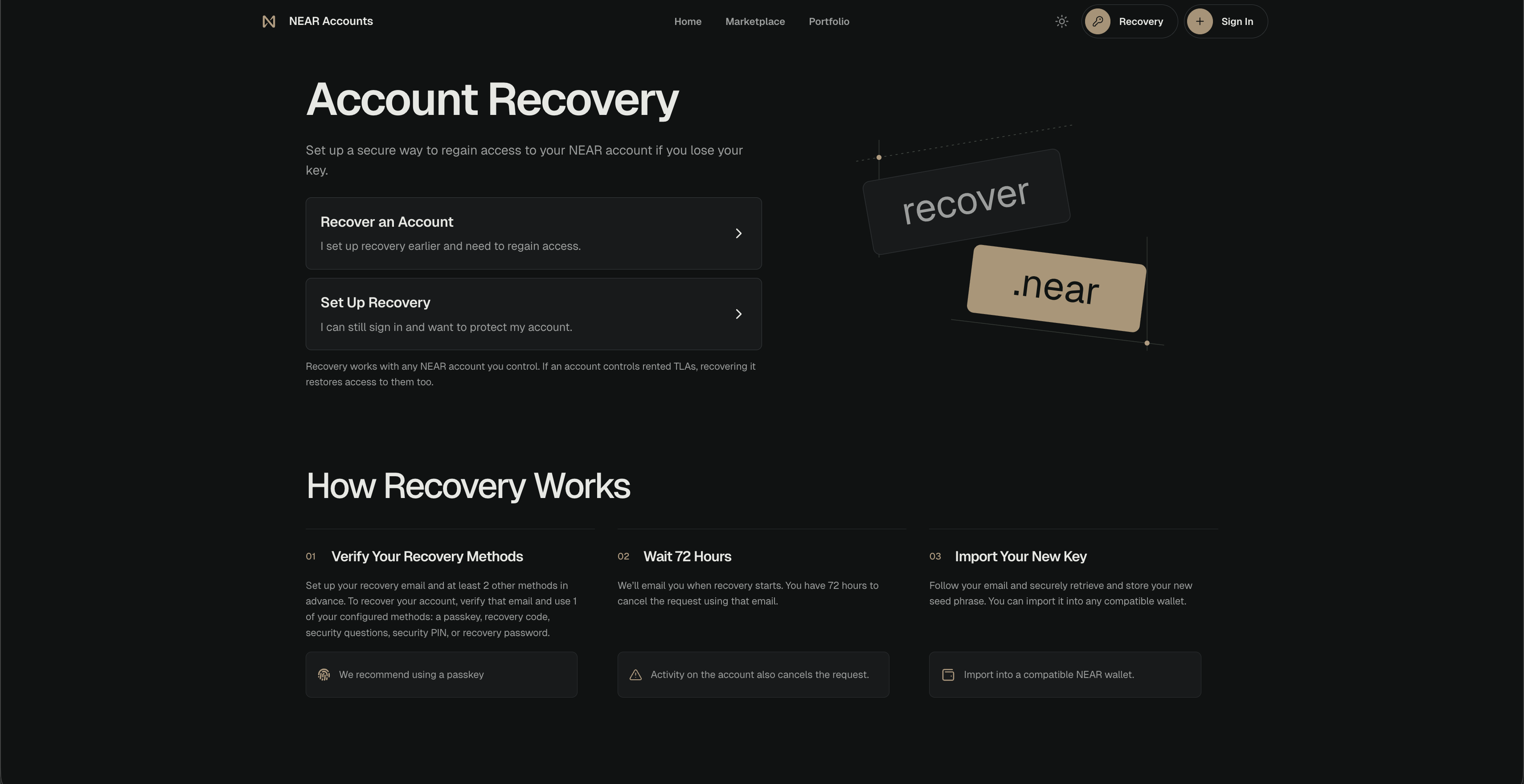
nearaccounts.com is also introducing Recovery Keys for NEAR accounts.
Recovery is opt-in, available for traditional .near accounts, and can also restore access to rented Top Level Accounts connected to them. There is no recovery fee.
A recovery request must pass through the official recovery flow, a timelock, and approval from an independent group of watchers.
During the timelock, the owner is notified and can cancel the request. If the account state changes while recovery is underway, the pending recovery becomes invalid.
The goal is simple: make account recovery possible without giving any single organization the power to unilaterally take control.
Namespaces for communities, businesses, and AI agents
Top Level Accounts become especially powerful when used as namespaces.
An organization can license a namespace and issue accounts beneath it to customers, communities, employees, applications, or autonomous agents.
This allows an organization to define how names are distributed and priced while giving every account its own onchain identity.
For teams putting AI agents into production, this solves the problem that policy documents cannot.
An agent can receive an account under an organization's namespace, hold assets, transact, and interact with applications while remaining accountable to the entity operating it.
The account cannot independently add full-access keys or delete itself.
If necessary, the organization can freeze, recover, transfer, or reclaim the account according to the rules of the namespace.
The namespace itself also provides visible context about who issued the account.
As autonomous agents begin participating more actively in digital economies, infrastructure like this can help establish a clearer relationship between agents, their operators, and the assets they control.
Governance that delivers infrastructure
Top Level Accounts and Recovery Keys also demonstrate a broader direction for House of Stake.
Onchain governance is often associated primarily with proposals and voting.
House of Stake is exploring a broader model where governance can also coordinate and deliver infrastructure and services that benefit the NEAR ecosystem.
This initiative takes an idea described in NEAR's original account architecture and turns it into infrastructure that users can access today.
Users can now search for a Top Level Account, enable recovery for an existing NEAR account, or explore namespace opportunities for their organization.
Get started
If the Top Level Account you want is not yet available, you can also submit a request for review.
Top Level Accounts and Recovery Keys are live today, delivered by nearaccounts.com and House of Stake and made available to the NEAR ecosystem.
This is an early example of what governance-powered infrastructure may look like as House of Stake continues to explore its role within the NEAR ecosystem.
House of Stake is a community governance mechanism within the NEAR ecosystem. Participation in governance does not constitute an investment activity and does not entitle participants to financial returns of any kind.
Vote at House of Stake: https://houseofstake.org/proposals
Participate in governance: https://houseofstake.org/assets
Telegram: https://t.me/NEAR_HouseOfStake
Announcements: https://t.me/HOSannouncements
X: https://x.com/NEARGovernance
Discussions: https://gov.near.org/c/house-of-stake/158
Nothing in this communication constitutes investment advice, a solicitation, or an offer to buy or sell any token or other financial instrument. The strategies, tools, and approaches discussed are subject to change and may be modified or discontinued at any time based on regulatory developments, governance decisions, or other factors. NEAR token holders have no rights vis-a-vis the NEAR Foundation.