

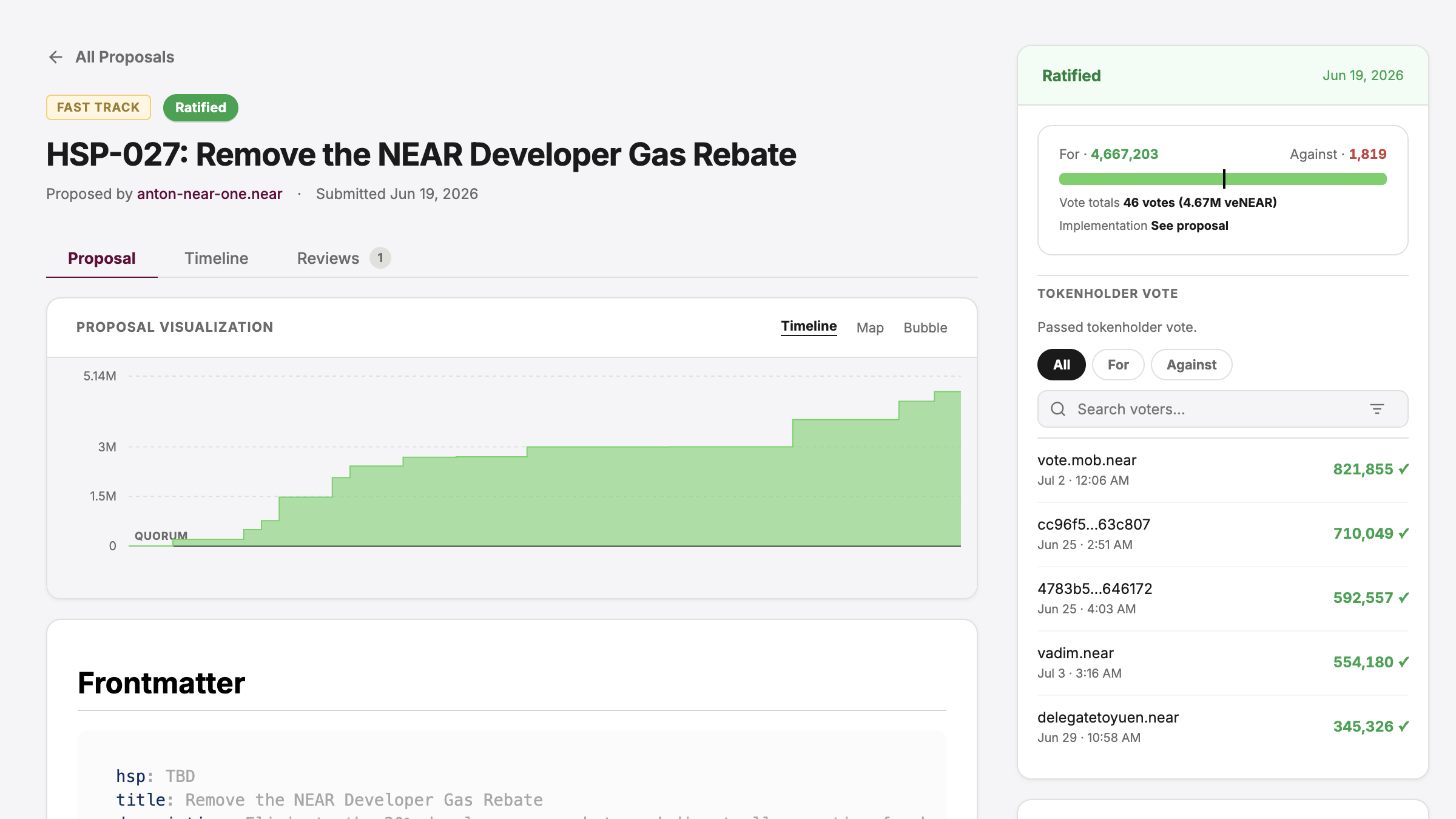
On July 3, 2026, the House of Stake ratified HSP-027: Remove the NEAR Developer Gas Rebate, completing the governance process for the proposal.
With governance concluded, the proposal now moves into the implementation phase. This update summarizes the expected rollout, what developers and builders should expect, and the current implementation timeline.
Implementation Timeline
Ratification does not immediately change protocol behavior.
The proposal is scheduled to be implemented as part of Protocol Update v2.14, currently targeted for August 2026. As with all protocol upgrades, the final activation date depends on engineering readiness, testing, and validator coordination.
Implementation is expected to proceed in three stages.
Phase 1: Protocol Implementation
The required changes are implemented in the nearcore codebase.
The protocol parameter governing the developer gas rebate will be updated from 30% to 0%.
No other transaction fee parameters are expected to change.
Phase 2: Testnet Validation
The v2.14 release candidate will be deployed to Testnet, where contributors will validate:
- transaction execution;
- contract compatibility;
- fee accounting;
- validator operation and consensus.
Phase 3: Mainnet Activation
After successful testing and validator upgrades, Protocol Update v2.14 will be activated on Mainnet.
Once activated:
- the developer gas rebate becomes 0%;
- 100% of eligible execution fees are now allocated to the protocol's existing fee-processing mechanism;
- validator rewards, gas pricing, and user transaction fees remain unchanged.
What Developers Should Expect
For application developers, the implementation is expected to be operationally straightforward.
The update does not introduce:
- breaking API changes;
- contract migrations or redeployments;
- changes to gas pricing;
- changes to validator economics.
The primary behavioral change is that contract owners will no longer receive the automatic protocol-level rebate on gas consumed during contract execution.
For most existing applications, no code changes are expected to be required.
Background
The developer gas rebate was introduced during NEAR's early growth to encourage smart contract deployment by returning a portion of execution fees to contract owners.
HSP-027 proposed removing that mechanism and directing 100% of eligible execution fees to the protocol's existing fee mechanism.
During the governance process, discussion covered several themes, including:
- the long-term complexity of maintaining the rebate mechanism within the protocol;
- historical data indicating that the rebate was not a significant source of funding for the majority of applications;
- available data suggesting that where the rebate constituted meaningful revenue, those applications were generally mature enough to absorb the change through existing business models;
- the compatibility of the rebate mechanism with future protocol architectures, including global and sharded contracts.
Community members can review the complete proposal, discussion, and supporting analysis on the House of Stake proposal page.
Preparing for Future Protocol Architecture
As outlined during the proposal discussion, one motivation for the change is simplifying dApp development. The existing rebate model assumes execution within a traditional single-contract account. As NEAR evolves toward sharded contracts, maintaining rebate accounting across large numbers of user-controlled accounts would introduce significant complexity for application developers in order to continue claiming these rewards.
Removing the rebate eliminates that dependency in addition to making the protocol simpler.
Monitoring the Rollout (KPIs)
Following activation, implementation will be considered successful if:
- the developer rebate is reduced to 0% across the network;
- protocol fee allocation reflects the updated parameters;
- validator and network performance remain stable throughout the upgrade;
- no unintended impact is observed for transaction execution or developer tooling.
House of Stake will continue to provide implementation updates as Protocol Update v2.14 progresses through testing and toward Mainnet activation.
Message from the Proposal Author
I'd like to thank everyone who participated in the discussion and voting process, regardless of their position on the proposal.
The proposal received strong support through House of Stake governance, reflecting broad agreement that the developer rebate had fulfilled its original purpose and that simplifying the protocol is the right long-term direction.
At the same time, I recognize that this change will affect some builders more than others. While the available data suggests the rebate was not a significant source of revenue for most applications, some smaller teams and independent developers will lose a modest stream of income. I want to acknowledge that impact and thank those builders for the work they continue to do across the ecosystem.
My hope is that this change helps create a simpler protocol that better supports long-term ecosystem growth, and the next generation of applications on NEAR.
Let's continue to shape that future together.
Anton Astafiev / CTO NEAR One, proposal author
House of Stake is a community governance mechanism within the NEAR ecosystem. Participation in governance does not constitute an investment activity and does not entitle participants to financial returns of any kind.
Vote at House of Stake: https://houseofstake.org/proposals
Acquire voting power: https://houseofstake.org/assets
Telegram: https://t.me/NEAR_HouseOfStake
Announcements: https://t.me/HOSannouncements
X: https://x.com/NEARGovernance
Discussions: https://gov.near.org/c/house-of-stake/158
Nothing in this communication constitutes investment advice, a solicitation, or an offer to buy or sell any token or other financial instrument. The strategies, tools, and approaches discussed are subject to change and may be modified or discontinued at any time based on regulatory developments, governance decisions, or other factors. NEAR token holders have no rights vis-a-vis the NEAR Foundation.